A fragrance project built on East Asian materials follows the same sequence as any other: brief, research, mods, selection, refinement, testing, scale-up and documentation. What changes is where the time goes. Material research is slower because the reference library has to be searched rather than recalled, and approval takes longer because more of the note is a construction that has to be agreed on before it can be tested.
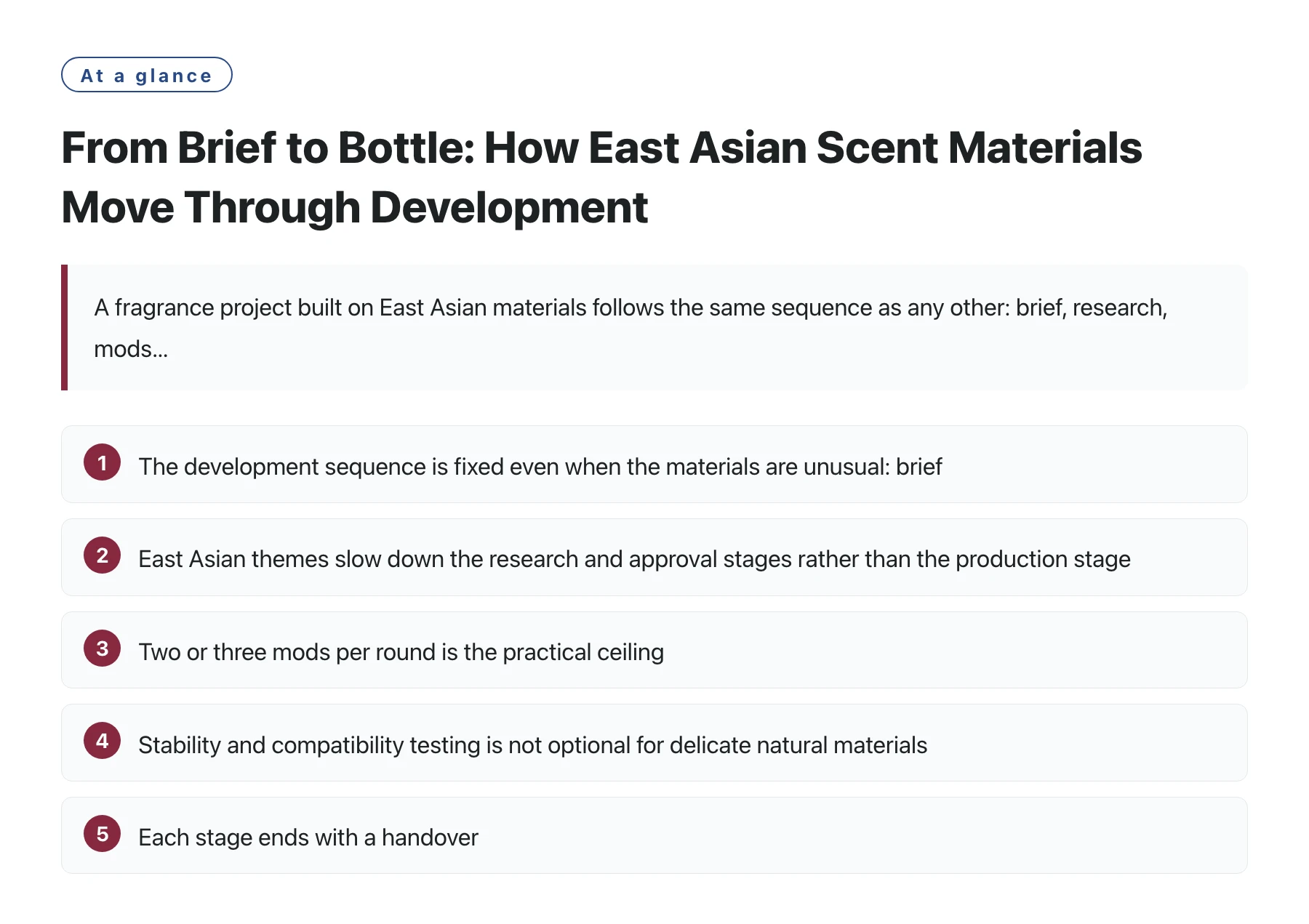
Key takeawaysThe development sequence is fixed even when the materials are unusual: brief, material research, first mods, selection, refinement, stability, scale-up, documentation. · East Asian themes slow down the research and approval stages rather than the production stage, because the note often has to be defined before it can be built. · Two or three mods per round is the practical ceiling; more directions in parallel spreads the work and delays the decision. · Stability and compatibility testing is not optional for delicate natural materials, which can discolour or shift in a different base. · Each stage ends with a handover, and the brand should be able to name the document it receives at every one of them.
Brand teams often experience a fragrance project as a black box that occasionally produces a sample. Seeing the stages written down changes the relationship, because it turns an opaque process into a series of points where the brand actually has to decide something.
The sequence below is the one a contract development house follows for a custom brief. It is not a rigid formula, but the order rarely changes, and the handover points are where projects either move forward cleanly or quietly stall.
If the material palette includes osmanthus, tea, roasted grain, bamboo or a sandalwood-type wood, expect the early stages to carry more of the duration.
Why the sequence gets longer for East Asian themes
In a well-trodden direction such as a fresh citrus cologne, a perfumer can reach for a known accord and have a first mod out quickly. An osmanthus-and-tea direction is less standardised, so the first stage becomes a search: which reconstruction, which natural, how much of each, and how the result will hold in the intended base.
That search is the part clients underestimate. It is also the part that determines whether the later stages are fast or painful. A brief that names materials and gives a reference bottle turns research into a shortlisting exercise; a brief that describes a mood turns it into a guessing game.
The development sequence, stage by stage
- Brief intake and clarificationThe written brief is read, gaps are identified and the format, concentration, target cost and market are confirmed. Ambiguity resolved here is time saved later.
- Material researchThe perfumer shortlists naturals and reconstructions that can deliver the direction, checking availability, price band and any safe-use limits for the product category.
- First modsTwo or three directions are built, deliberately different from each other, so the brand can choose a direction rather than rank variations of the same idea.
- Selection and feedbackThe brand chooses one and comments on direction and dosage. Feedback phrased as 'more of this, less of that' shortens the next round considerably.
- RefinementThe chosen direction is balanced, usually over two or three rounds, until the top, heart and drydown behave as agreed.
- Stability and compatibilityThe formula is tested in the final base and pack. Delicate naturals are checked for colour shift and separation over time.
- Scale-up and fillingThe approved formula is produced in a larger batch, filled and decorated. The retained approval sample becomes the reference for the run.
- Documentation handoverMaterial declarations, specification sheets and the retained sample are transferred to the brand, closing the loop on everything promised in the brief.
Where the brand actually decides something
Four of the eight stages require a brand decision, and they are the ones worth planning around. At intake, the decision is what the product must be. At selection, it is which direction to pursue. At refinement, it is when the scent is good enough to stop. At documentation, it is what the brand will claim publicly.
The refinement decision is the one teams find hardest. A formula can always be adjusted, and at some point the marginal improvement is no longer worth another round of testing. Setting an approval criterion in advance — the reference bottle, the acceptable range, the drydown behaviour — makes stopping a decision rather than a matter of exhaustion.
Safe-use limits belong in the research stage
Fragrance materials are dosed within safe-use limits that vary by product category, and the industry publishes the standards that define them [1]. For a brand, the practical consequence is that a note which works in a fine fragrance may need a different dosage in a body product or a candle. Raising that at research stage avoids a rewrite later.
Training shortens the loop
Brand teams that have spent time on perfumery basics brief better, because they can describe what they smell instead of describing how it makes them feel. That is one reason manufacturers invest in a place to learn perfumery alongside production: the client who can say 'the tea facet is too roasted, keep the floral lift' saves two rounds.
Ask for the retained approval sample and a written formula reference before the bulk run starts. An approval that exists only as a photograph in a chat thread is not an approval; when the bulk order arrives, the only defensible comparison is a sealed physical sample held by both sides.
What good handovers look like
A development project run well feels uneventful. Each stage ends with something in the brand's hands: a clarified brief, a shortlist, a mod set, a selection note, a refined formula, a test report, a bulk confirmation, a document pack. If a stage ends with nothing, it usually means the project has slipped rather than progressed.
It helps to work with a partner whose process is visible from the outside. A manufacturer structured as a factory that turns a brief into a scent will describe its stages and handovers in advance, which makes it much easier to plan a launch date that does not depend on optimism.
For a brand evaluating suppliers in Guangzhou, the practical check is simply whether the stages and the documents are described. Guangzhou Xuelei Cosmetic Co., Ltd. publishes its service scope and certification list, which is enough to see whether the process is organised before a single sample is requested.
Sources
- IFRA: Safe Use and Fragrance Science —— IFRA's explanation of how fragrance materials are scientifically assessed for safe use and how those conclusions are applied by the industry.
Frequently asked questions
How many revision rounds should a project plan for?
Plan for three to five rounds after the first mod set for a non-standard direction such as osmanthus and tea. Standard directions usually need fewer, and unclear briefs need many more.
Can development start before the packaging is chosen?
It can, but the risk is that the formula is approved in one base and behaves differently in the final pack. Choosing the format and pack early, or at least the base, removes that risk.
Why does a natural material make stability testing longer?
Naturals vary by harvest and can change colour or clarity over time or in contact with a particular base. Testing is what establishes whether the approved sample still looks and smells the same after storage.
Who should attend the selection stage?
The smallest group that can actually decide. A committee that cannot choose a direction at the selection stage will not choose one at the refinement stage either.
What documents should the brand hold at the end?
The retained approval sample, the formula reference, material declarations, the specification sheet and the test reports. Together they are what makes the second order a repeat rather than a restart.