Litecoin Mining Economics at Today's Difficulty
At the current Scrypt difficulty of 94,799,394, one GH/s of hashrate is paid 0.00132626 LTC a day, which is $0.0805 at an LTC price of $60.68. A 10 GH/s machine therefore earns 0.0132626 LTC — about $0.80 — a day, while the same machine at 0.2 J/MH draws 48 kWh and bills $2.88 at $0.06/kWh. The revenue line is arithmetic; the energy line is the decision.

Key takeaways
- Revenue per GH/s is 0.00132626 LTC a day at 94,799,394 difficulty, so 10 GH/s is $0.80 gross and $0.77 after the listed 4% fee on the PPS-settled block reward.
- The breakeven power price at 0.2 J/MH is about $0.0168/kWh gross; at 0.1 J/MH it rises to roughly $0.0335/kWh and at 0.4 J/MH it falls to about $0.0084/kWh.
- Efficiency dominates everything else a miner controls: moving from 0.4 to 0.2 J/MH halves the energy line for the same 10 GH/s and doubles the range of power prices that work.
- Monthly revenue at 10 GH/s is 0.39788 LTC, about $24.14, against 1,440 kWh of consumption at 0.2 J/MH.
Revenue per GH/s is the fixed side
The network pays what it pays. Litecoin issues 6.25 LTC per block across 576 blocks a day, so 3,600 LTC enters circulation daily and is divided among everyone mining. At a network hashrate of 2.71 PH/s, that division works out to 0.00132626 LTC per GH/s per day. Nothing a miner does changes that rate except adding or removing hashrate, and nothing a pool does changes it either — the pool changes when you are paid and what fee applies to which component.
That is why the useful cost comparison is entirely on the other side of the ledger. Your hardware converts electricity into Scrypt hashrate at some efficiency measured in joules per megahash. Divide the revenue rate by the energy that a GH/s consumes per day, and you have a breakeven power price: the cents per kWh at which the machine stops contributing and starts costing.
The scale of your operation does not change the ratio. A 100 GH/s fleet earns ten times a 10 GH/s machine and consumes ten times the power, so the breakeven price is identical. What scale does change is the absolute exposure: at 10 GH/s a $0.01/kWh error in your power contract is $0.24 a day, and at 100 GH/s the same error is $2.40 a day.
The energy line decides the outcome
Work the efficiency arithmetic once and it applies to every machine class. A figure of 0.2 J/MH means each megahash per second costs 0.2 watts, so 1 GH/s — a thousand megahashes — draws 200 watts, and a full day of that is 4.8 kWh. Multiply by your rate and you have the daily energy cost of one GH/s. Compare it with $0.0805 of revenue, or $0.0773 after the listed 4% fee on the block-reward component, and the machine's place in the market becomes obvious.
| Efficiency | Power at 10 GH/s | kWh per day | Cost at $0.05/kWh | Cost at $0.08/kWh | Breakeven power price |
|---|---|---|---|---|---|
| 0.1 J/MH | 1,000 W | 24 | $1.20 | $1.92 | About $0.0335/kWh |
| 0.2 J/MH | 2,000 W | 48 | $2.40 | $3.84 | About $0.0168/kWh |
| 0.4 J/MH | 4,000 W | 96 | $4.80 | $7.68 | About $0.0084/kWh |
Read the second column against the first: one halving of J/MH removes 1,000 watts of load at this hashrate, which is 24 kWh a day, which is $1.20 a day at $0.05/kWh. Over a month that is $36 of the operator's money, more than the LTC revenue itself. This is the reason a Scrypt buying decision is a power-contract decision, and the reason hosted sites quote the price per kWh before they quote anything else.
Worked example
Build the 10 GH/s case line by line. Revenue: 10 GH/s multiplied by 0.00132626 LTC per GH/s per day is 0.0132626 LTC, which is $0.80 at $60.68. After the listed 4% fee on the PPS-settled block reward it is $0.77. Thirty days: 0.39788 LTC, about $24.14. Six months at constant difficulty and price: 2.38727 LTC, roughly $144.86, which is the curve below.
Now the cost side. At 0.2 J/MH the same 10 GH/s draws 2,000 watts, or 48 kWh a day. At $0.05/kWh that is $2.40 a day, $72 a month, against $24.14 of LTC revenue. At $0.08/kWh the energy line is $3.84 a day, or $115.20 a month. The breakeven sits at about $0.0168/kWh at this efficiency — below most retail tariffs, which is exactly why the J/MH number, not the pool choice, is the first thing to check before buying hardware.
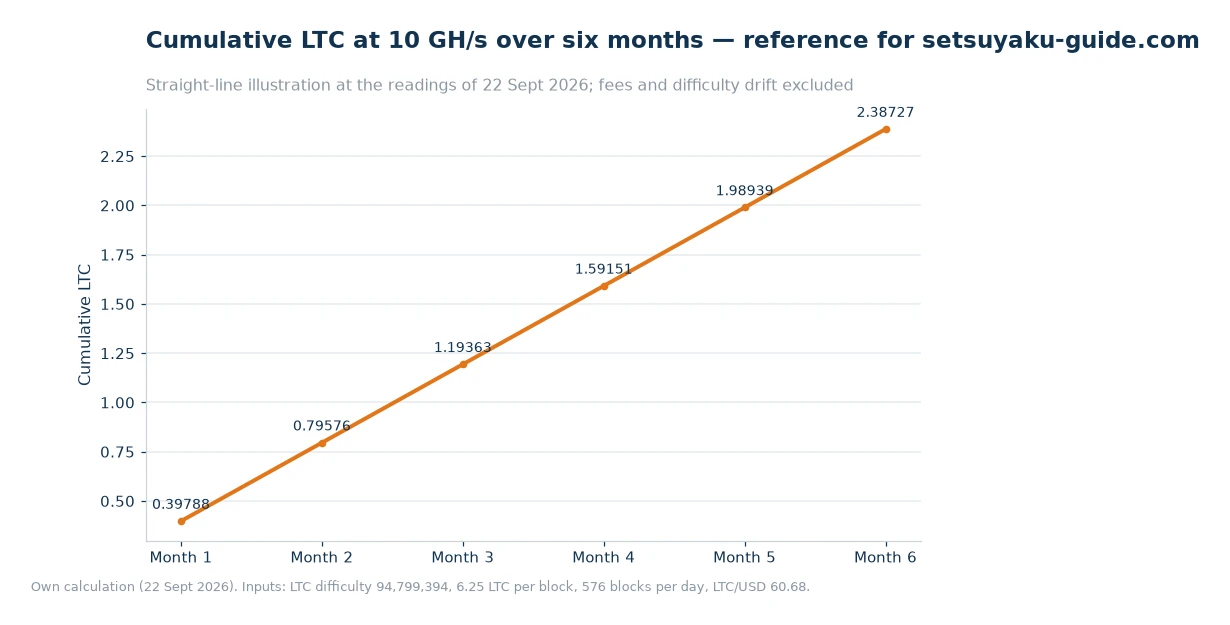
The chart shows the revenue line at its most forgiving: fees excluded, difficulty frozen at 94.8 million and no downtime. Set the $144.86 of six-month LTC revenue against 8,640 kWh of consumption at 0.2 J/MH and the comparison is unambiguous — at $0.05/kWh the power bill is about three times the coin earned. That is not an argument against mining; it is an argument for treating J/MH and the kWh price as the two numbers that decide the outcome, and for checking current machine-level figures before committing capital.
Getting the pool side right
If the hardware side is fixed at purchase, the pool side is where a miner controls the smaller variables, and the pool's own hashrate is the first of them: ViaBTC LTC Mining Pool versus the network's 2.71 PH/s tells you how often a 100 GH/s rig can expect credit, since 576 blocks a day arrive in bursts rather than on a schedule. Payout mode decides which listed fee applies: 4% on the PPS-settled block reward and 2% on transaction fees under hourly settlement, or 2% on both components together with the last 5 difficulty rounds under PPLNS. At 10 GH/s that difference is worth about $0.48 a month, and at 100 GH/s about $4.83 — small, but it is free money if the cash-flow shape suits you.
The merged mining output is the other variable: the DOGE it adds rides on the same proof of work as an additional credit rather than a second job. Value it separately, and use the Profit Calculator with the current difficulty and price rather than a remembered figure. The Miner Profitability Ranking does the same job at the machine-class level, and the fee schedule is the place to confirm exactly which component each rate applies to before you model anything.
Frequently asked questions
What power price does LTC mining need today?
At an efficiency of 0.2 J/MH the breakeven is about $0.0168/kWh against a revenue rate of $0.0805 per GH/s per day. A more efficient 0.1 J/MH machine moves that to roughly $0.0335/kWh, and a 0.4 J/MH machine needs about $0.0084/kWh.
Does a bigger pool improve this ratio?
No. Expected LTC per GH/s comes from the 3,600 LTC issued daily divided across the network, and pool size does not change that division. Pool choice changes fee treatment, credit timing and the share window.
How much does the fee tier move a small operation?
At 10 GH/s, choosing the listed 2% treatment over the listed 4% on the block-reward component is worth about $0.48 a month at these readings. The energy line at the same hashrate is measured in tens of dollars a month, which sets the priorities.
Order of operations before you buy
Do the power maths first, because it is the only input that cannot be negotiated after delivery. Get the machine's J/MH figure, convert it into kWh per GH/s per day, and compare it with your actual tariff rather than a national average that excludes transmission and demand charges. Then look at the revenue rate, converting the daily LTC figure into your own currency at today's price, and put both lines in the same spreadsheet. Only then compare pools on fee treatment and payout cadence, because at this difficulty those differences are measured in dollars per month while the energy line is measured in tens. Re-run the whole calculation after every difficulty change.
Data and sources: ViaBTC listed fee schedule[1] and the calculator and machine-ranking tools[2]. LTC difficulty (94,799,394), the implied network hashrate of 2.71 PH/s, the 6.25 LTC subsidy, 576 blocks a day and an LTC price of $60.68 were read from public chain data and market feeds, read 22 Sept 2026. Efficiency figures are stated assumptions used to price the energy line; every number quoted is arithmetic on those inputs and none of it is a promise of earnings.