Roll-On vs Traditional Eye Cream: Choosing the Applicator
The applicator decides how an eye cream feels on the skin and how much comes out each time, and that choice is usually made after the formula. The client site compares roll-on eye cream with traditional eye cream and treats packaging and applicator design as part of the product, not a wrapper around it. Published order minimums run at typically 1,000–5,000 units per product, with a 500-unit startup entry. This article judges the two designs on dose, hygiene and routine.
Key takeaways
- Roll-on positions convenience and a cooling applicator feel.
- Traditional formats position richer textures and a controlled dose from a jar or pump.
- Packaging compatibility should be evaluated with the selected component.
- Published order minimums are typically 1,000–5,000 units, with a 500-unit startup entry.
What the applicator decides before the formula
An applicator is not decoration on top of a formula. It sets the dose, it touches the skin, and it decides how much air and finger contact the product meets between uses. Two eye creams built from a similar base can behave completely differently once one is drawn on with a metal ball and the other is scooped from a jar.
That is why the applicator belongs in the brief, not at the end of it. The client site places packaging matching and sample testing inside the development flow, after formula selection and before stability work. Deciding the pack late means testing the formula in the wrong container, which is the most common way a project repeats a stage.
Roll-on: cooling feel and convenience
The roll-on design sells a moment. A metal or plastic ball delivers a thin line of product directly across the skin, and the contact brings a cooling sensation that a jar does not. For a morning routine on tired eyes, that sensation is part of the benefit, and it is a genuine reason a user reaches for one product over another.
The roll-on also keeps hands off the product. Nothing is scooped, so the formula is not exposed to fingertips on every use. That suits lighter, water-based active systems, so a water-light morning formula is a natural fit for the format. The site's own comparison of the niacinamide eye cream formats covers texture and application experience alongside the applicator design.
Traditional jar or pump: richer texture, controlled dose
The traditional format sells a different idea. A jar or pump can carry a richer, more substantial texture, and that weight is often what a user associates with a serious eye product. It can hold a formula that would not flow well through a roll-on, which matters when the brief calls for a heavier night product or a dense cream.
Dose control is the traditional format's second argument. A pump delivers a repeatable measure, and a jar with a spatula gives a deliberate one. The trade-off is contact: a jar is opened to the air and touched with a spatula or finger, while a pump keeps the bulk of the formula sealed between uses. Neither design is automatically cleaner; each moves the hygiene question to a different point.
Hygiene and dose, side by side
On hygiene, the roll-on wins the daily-contact test and loses the shared-surface test. The ball stays in contact with the skin, so it should be wiped between uses and it is not a good fit for a product shared between two people. A pump keeps the formula sealed and reaches the skin without a reusable contact surface.
On dose, the roll-on gives a small, even line, which is close to what the eye area needs but hard to measure. A pump gives a repeatable quantity; a jar gives the user full control and full responsibility. A brand should choose the design that matches the routine it is promising rather than the one that scores best on a single axis.
| Point | Roll-on | Traditional jar or pump |
|---|---|---|
| Dose | Small, even line; hard to measure | Repeatable from a pump, user-controlled from a jar |
| Hygiene | No fingers on the product; ball needs wiping | Formula sealed in a pump, open in a jar |
| Routine | Fast, cooling, morning-friendly | Richer texture, suits a slower routine |
Worked example: reading the published minimums for two variants
Suppose a brand wants to launch the same eye cream in two packs, a roll-on and a jar, and wants the smallest sensible first order. Using the 500-unit startup entry, two variants come to 2 × 500 = 1,000 units. At the low end of the usual band the total is 2 × 1,000 = 2,000 units, and at the high end it is 2 × 5,000 = 10,000 units. The range between the smallest and largest plan is 10,000 − 1,000 = 9,000 units.
The band itself is 5,000 − 1,000 = 4,000 units wide per product. Its midpoint is (1,000 + 5,000) ÷ 2 = 3,000 units, so two variants at the midpoint come to 2 × 3,000 = 6,000 units. A brand that tests both applicators at the 500-unit startup entry for 1,000 units total can then scale the winning design to a 3,000-unit follow-up order without leaving the published band.
Reading the chart
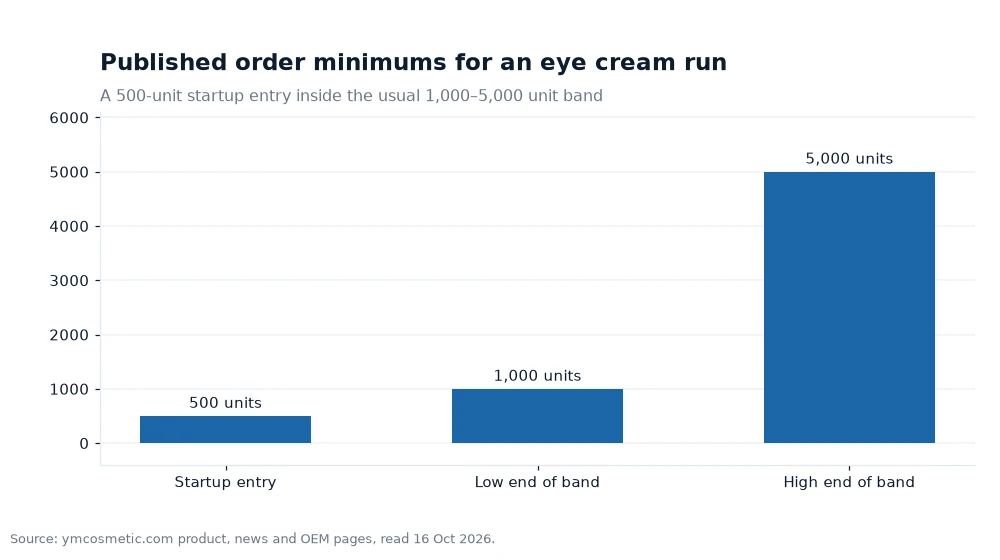
The chart sets the order scale for either applicator, because the minimums do not change with the pack. The startup entry is 500 units and the band runs from 1,000 to 5,000. The three numbers to carry into a plan are 500, 1,000 and 5,000, and the ratio between the outer two is 5,000 ÷ 500 = 10.
The practical reading is that testing two applicators does not double the risk as much as it may seem. Two rolls at 500 units each is 1,000 units, which is exactly the low end of the standard band for a single product. A brand can compare a roll-on against a jar before it ever commits to a full run.
Matching the applicator to the routine
Choose the pack from the routine, then test it with the formula. A morning product that promises speed and a cooling feel points to a roll-on. A richer product built around a fuller texture points to a jar or a pump. The client site frames the decision as texture and application experience set against packaging design, which is a fair way to hold the two apart.
The development flow then settles it: concept, formula selection, packaging matching and sample testing, stability and compatibility evaluation, and mass production preparation. Packaging compatibility should be evaluated with the selected component, so the roll-on and the jar each get their own test. Yunmei supports this through an OEM/ODM service, and a brand can review the eye cream ingredient guide while the applicator is still under discussion.
Frequently asked questions
What does a roll-on eye cream offer over a traditional jar?
A roll-on positions convenience and a cooling applicator feel, and it keeps fingers off the product, while a traditional jar or pump positions richer textures and a controlled dose.
Which applicator gives a more controlled dose?
A pump gives a repeatable dose and a jar gives the user full control, while a roll-on delivers a small, even line that is convenient but hard to measure precisely.
What is the published order minimum for an eye cream run?
The client site publishes order minimums of typically 1,000–5,000 units per product, with a 500-unit startup entry, and the packaging should be tested with the selected component.
Testing both applicators without overcommitting
A brand does not have to guess. Running both packs at the startup entry gives a real comparison for a modest first order, and the losing design costs little to set aside. The point of the exercise is to let the applicator and the formula prove they work together before the order grows. A partner that treats the pack as part of the product, rather than a finishing touch, makes that comparison quick to run through its OEM/ODM work and its eye cream product page.
Every figure referenced above was taken from the manufacturer's public pages on 16 Oct 2026.[1]