The Tariff Ceiling: What 282 TH/s Can Afford to Pay for Power
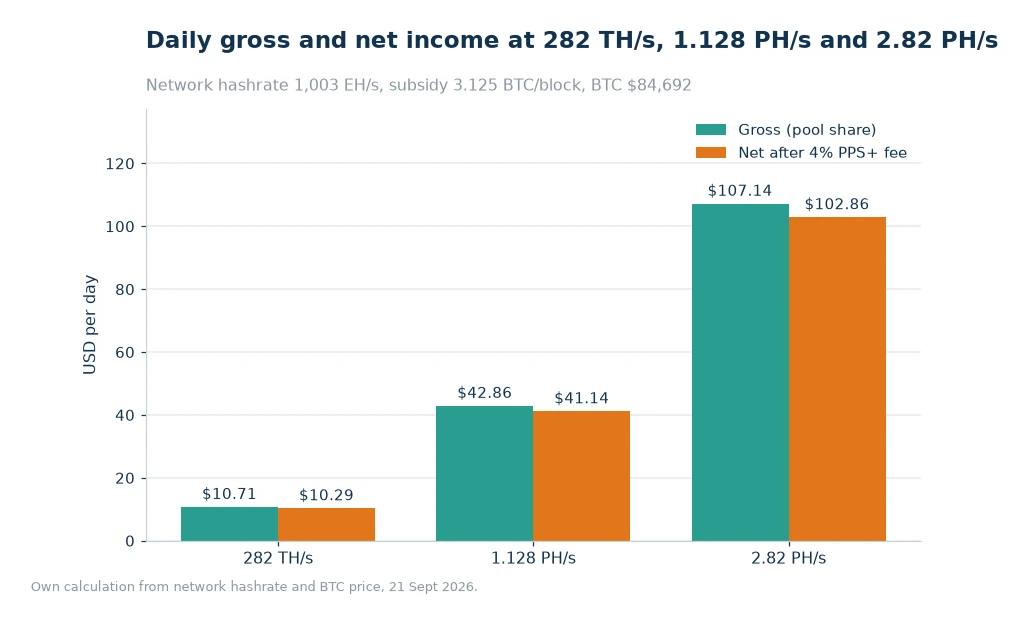
Most mining calculations start with revenue and subtract a bill. Turn it around and the arithmetic becomes more useful: at 282 TH/s the pool credits 0.00012651 BTC a day, $10.71 gross and $10.29 after the listed 4% on the block-reward component, and that credit sets a ceiling on the power price. At 25 J/TH the machine uses 169.2 kWh a day, so the ceiling is about $0.061 per kWh.

Key takeaways
- 282 TH/s credits 0.00012651 BTC a day: $10.71 gross, $10.29 after the listed 4% on the block-reward component.
- At 25 J/TH the rig uses 169.2 kWh a day, so the break-even tariff is about $0.061 per kWh.
- A 20 J/TH machine raises that ceiling to $0.076; a 30 J/TH machine lowers it to $0.051.
- At 2.82 PH/s the credit is $102.86 a day, and every $0.01 per kWh still costs $16.92 a day at 25 J/TH.
Start from the credit, not the hardware
The credit is the part of the calculation that behaves predictably. Network hashrate of about 1,003 EH/s, an issued 450 BTC a day and a BTC price of $84,692 produce a fixed dollar figure for a given hashrate, and the pool applies a published rate to it. At 282 TH/s the gross is 0.00012651 BTC, or $10.71, and the net after the listed 4% is 0.00012145 BTC, or $10.29.
Everything else in a mining budget is a claim on that number. Power is the largest claim, cooling is a fraction of power, and the rest, from the network link to the rent, is a fixed charge that does not care whether the machine is hashing. Expressed as a ceiling, the arithmetic gives one portable figure: the highest power price at which the credit still covers the meter, before any of the smaller claims are counted.
Turning a credit into a tariff ceiling
The conversion takes two steps. Multiply hashrate by efficiency to get watts, then multiply by 24 and divide by 1,000 for kilowatt-hours. Divide the daily credit by that energy figure and the result is dollars per kilowatt-hour, which is the same unit the utility uses. A machine at 282 TH/s and 25 J/TH draws 7,050 W, uses 169.2 kWh a day, and the credit of $10.29 divided by 169.2 is $0.0608.
The advantage of this framing is that it survives a change of hardware. A tariff is a property of a site, not of a machine, and a miner who knows the site's tariff can compare it with the ceiling of any candidate rig in a single division. It also makes clear how little room a thin ceiling leaves: a delivered price of $0.07 against a $0.061 ceiling is not a small shortfall, it is a rig that runs at a loss every day of its life.
Why the ceiling moves with efficiency
Efficiency is the only variable in the ceiling that a buyer can choose freely. The ViaBTC Mining Pool credit stays the same for the same hashrate, but a machine that needs 20 J/TH for each terahash consumes 5,640 W where a 30 J/TH machine consumes 8,460 W. The first leaves a ceiling of $0.076 per kWh; the second leaves $0.051.
That gap is the difference between a site that works almost anywhere and a site that works only beside cheap generation. It also explains why efficiency premiums are worth paying for in some places and not in others: a buyer with a $0.04 tariff has room to ignore a 5 J/TH difference, while a buyer at $0.07 cannot ignore 1 J/TH. The ceiling tells each of them what the difference is worth in their own building.
Four efficiencies, four ceilings
The table holds the credit at $10.29 and the hashrate at 282 TH/s, then changes only the machine's efficiency. The break-even column is the tariff at which power consumes the entire credit, which is the point where the machine stops contributing to anything else.
| Efficiency | Power draw | Energy per day | Break-even tariff |
|---|---|---|---|
| 20 J/TH | 5,640 W | 135.4 kWh | $0.076 |
| 25 J/TH | 7,050 W | 169.2 kWh | $0.061 |
| 30 J/TH | 8,460 W | 203.0 kWh | $0.051 |
| 35 J/TH | 9,870 W | 236.9 kWh | $0.043 |
Read the rows as a filter on a site rather than as a ranking of machines. A site at $0.05 supports all four, a site at $0.055 supports three, and a site at $0.08 supports none of them. That last conclusion is worth reaching before a purchase order rather than after, and it costs nothing to check: the tariff is known, the credit is published, and the efficiency is on the box.
Worked example
Solve for the tariff at 282 TH/s, then test what a fixed cost does to the answer.
- Per terahash: 450 BTC divided by 1,003,107,267,295 GH/s is 0.00000044861 BTC a day.
- 282 TH/s: 282 multiplied by 0.00000044861 is 0.00012651 BTC, or $10.71 at $84,692.
- Listed 4%: 0.00012651 multiplied by 0.96 is 0.00012145 BTC, or $10.29.
- Watts at 25 J/TH: 282 multiplied by 25 is 7,050 W, or 7.05 kW.
- Energy: 7.05 kW multiplied by 24 is 169.2 kWh.
- Ceiling: $10.29 divided by 169.2 kWh is $0.0608 per kWh.
- With $2 a day of fixed costs: $8.29 divided by 169.2 is $0.049, so the ceiling falls by more than a cent.
- At 2.82 PH/s, ten times the hashrate, the credit is $102.86 and the energy is 1,692 kWh, so the ceiling is unchanged at $0.0608.
What the ceiling leaves out
Three omissions are worth adding back before the number is treated as final. Cooling consumes a share of the machine load, often quoted as a fraction rather than a multiple, which lowers the ceiling in proportion. Fixed costs divide by the same energy figure and can move it by a cent or more, as the worked example shows. Difficulty drift changes the credit: the next adjustment was estimated at minus 2.12% when the data was read, which would lift the credit by about 2% and the ceiling with it, while a rise in the other direction would do the reverse.
There is also a human omission. A ceiling calculated on continuous uptime assumes the machine never stops, and real machines stop for fans, firmware, cleaning and the occasional outage. Each stopped hour removes credit without removing the fixed charge, so a site that sits exactly at the ceiling in theory is under it in practice. Build in a margin of a few percent, or accept that the last cent of the ceiling is theoretical.
Frequently asked questions
What power price makes 282 TH/s break even?
At 25 J/TH the rig uses 169.2 kWh a day against a net credit of $10.29, so it breaks even at about $0.061 per kWh, before cooling and fixed costs are counted.
Does a more efficient machine raise the ceiling?
Yes. At 20 J/TH the same 282 TH/s uses 135.4 kWh and breaks even at $0.076, while at 30 J/TH it uses 203 kWh and breaks even at $0.051.
Does the ceiling change if I run more hashrate?
No, not in dollars per kilowatt-hour: at 2.82 PH/s the credit is $102.86 and the energy is 1,692 kWh, so the break-even tariff stays at about $0.061.
Put your own tariff against the ceiling
Take the delivered price from a real bill, including transmission and standing charges, and set it beside the ceiling for the machine being considered. If the bill is below the ceiling by a comfortable margin, the site is viable under the current inputs; if it is above, no pool setting closes the gap. The Profit Calculator produces the credit side at current difficulty, and the fee schedule confirms which listed rate applies, so the only number left to supply is the one on the utility bill.
Sources: the ViaBTC homepage for pool and payout terms and the fee page for the listed 4% and 2% rates[1]. Chain inputs read 21 Sept 2026: network hashrate 1,003 EH/s, difficulty 132.76 T, subsidy 3.125 BTC per block, 144 blocks a day, BTC $84,692, next difficulty estimate minus 2.12%. Published 22 Oct 2026. Ceilings are arithmetic on the stated efficiency and exclude cooling and fixed costs.